Parts done, progress made, funding in last stages of contract reviews, new Memorandum of Understanding announced!

“Parts done, progress made, funding in last stages of contract reviews, new Memorandum of Understanding announced!””
CEO & Founder
Expansion In Spite of the Noise
Yes, there has been a lot of concern lately about world issues, and rightfully so. But a business can get caught up in this and make no progress or go downhill. Samson is not one of those.
We have signed a Memorandum of Understanding in Tajikistan for the sale of 50 vehicles and help with pilot training, made real progress with groups in the USA for training of pilots and sales of bulk Switchblades, and are now closing in on our $100MM funding for the first US facility. We are expanding like crazy and invite people to expand with us!
A wise man once said, if you don’t shoot for the stars, you will never make it to the treetops. We are shooting for the stars with future commercial versions of the Switchblade able to carry Express Mail, organ donor material, and do pipeline and powerline security. This is a way for aspiring commercial pilots to gain tremendous numbers of flight hours in a short time and be paid decently for it.
So, let’s get down to what we have accomplished and I hope you will point yourself to the stars in your area or jump on our rocket ship and ride with us.
Parts Made and New Schedule
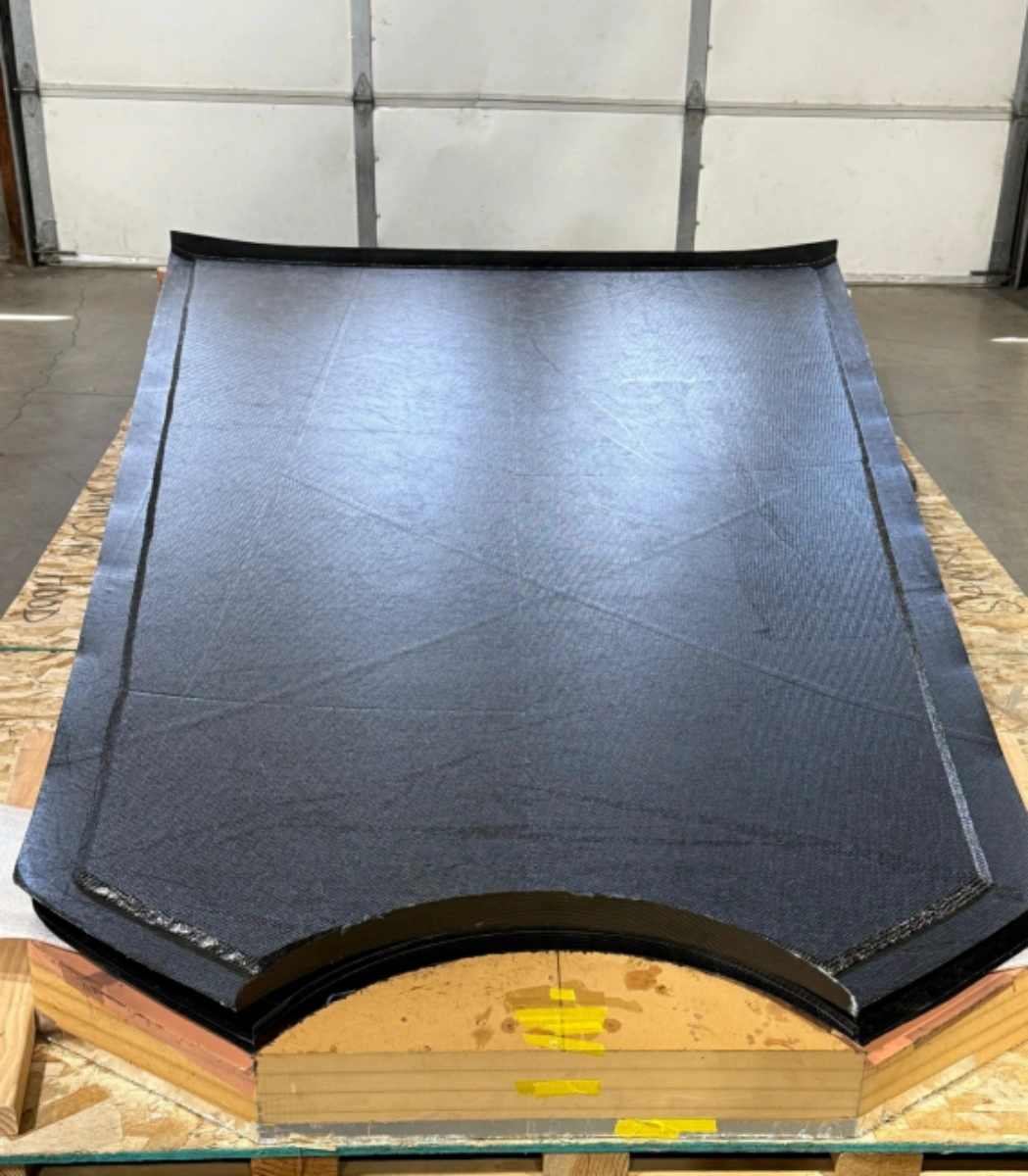
We received the three belly pan parts recently made (see image below). To save time, we are making three of everything, so the movement of molds and the repetition of making each part multiple times in a row bring a bit of cost and time savings. The downside is we have to pay for all three parts! The belly pans are very large parts, as you can see as they are in front of a 10′ wide roll-up door.
The belly pans look great and add to the host of parts waiting for the rest to be finished before we begin building the first production prototype. We are getting signals from our local parts manufacturer that they will have room for us in a month or so to run 2-3 months straight of parts through their doors. They haven’t had room for us for a while but we really needed to get through some engineering so we concentrated on the engineering.
The engineering is nearly done for the wings. We are approved to make body parts, so soon we can do wing skins, spars, ribs, and the remaining body parts as the next parts made. The body needs the rear hatch, bumper section, and the two door skins, plus a few bulkheads which are very simple molds and parts.
The tail is getting closer to being released to make parts. For that we plan on sending them to Phoenix Composites in Michigan (who did a great job building our tail booms for the first flying prototype) to make molds and parts and do the assembly there in a parallel path to our making the body and wings. This should speed things up quite a bit.
The local parts making availability coming up also coincides with the funding increasing, so this will be good timing for us!
Hybrid system testing
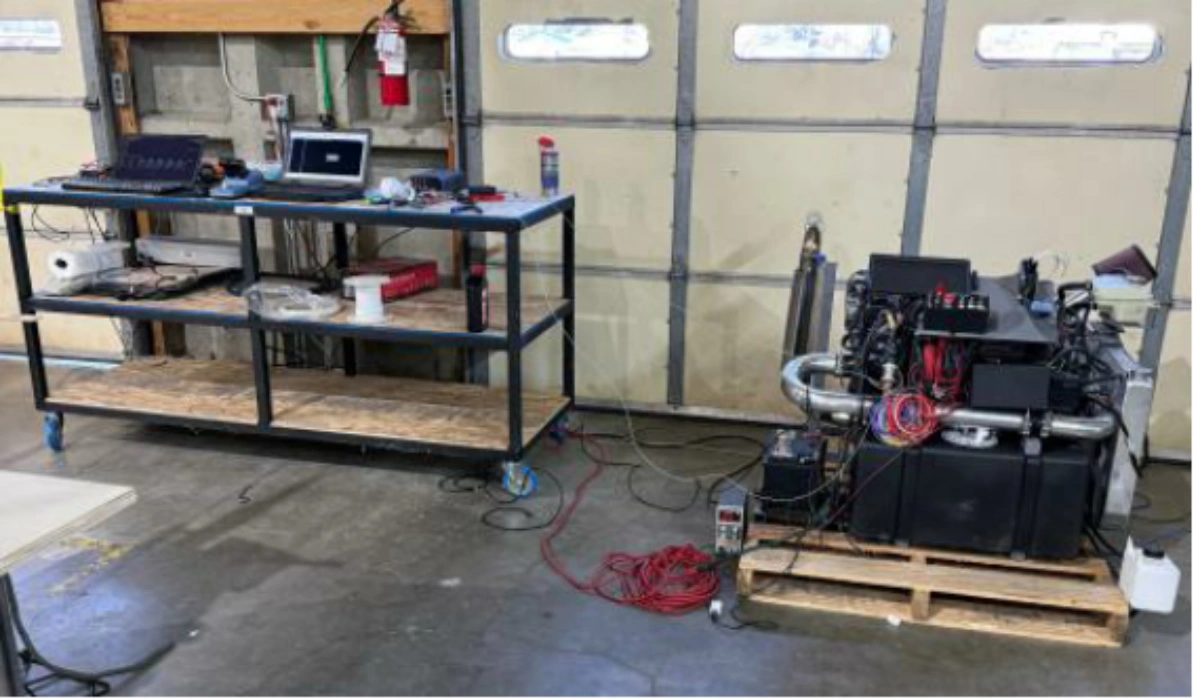
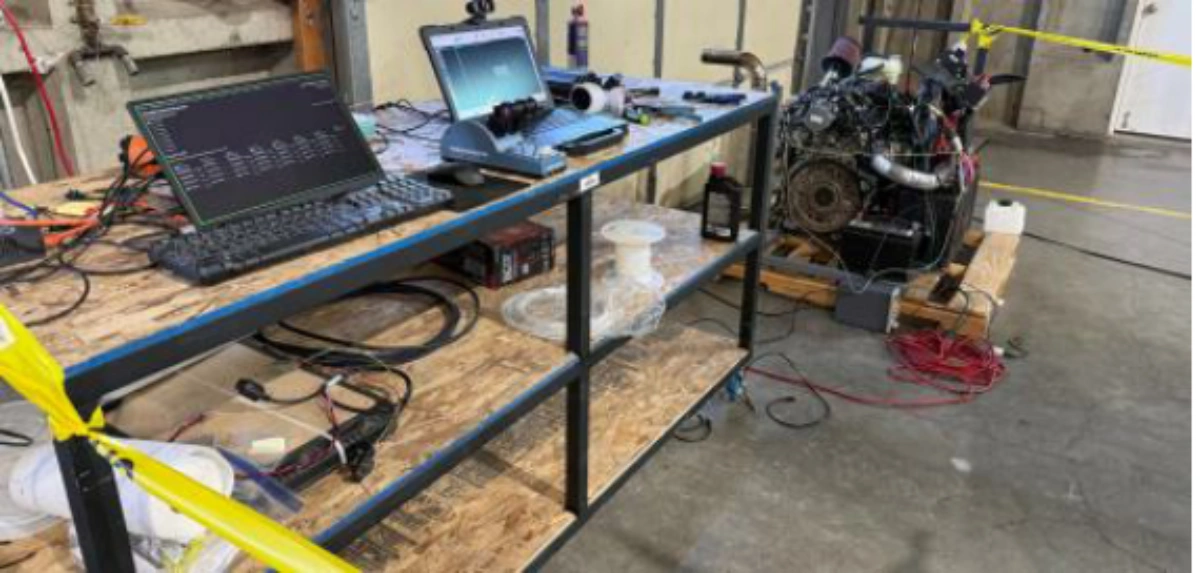
Shown above and below is the hybrid test area set up in the R&D Center in Oregon. Not shown is the setup in Indiana where the work is conducted remotely plugged into the computers and engine located in Oregon. This way we don’t have to ship the engine and all of the extra parts to that back east and then ship it back again when we go to physical testing. The engine on a stand is on the right side of the images. The computer stations are on the left side.
The engineers in Dayton plug right in and do their tests with our assistance here and then have been able to plug that into their analysis and results from the electric generator and motors we shipped to them earlier. The result has been further simplification of the system, particularly on the generator side, which removes weight, system parts, and cost from the hybrid setup. Like Musk has done at Space-X, we start with something, find parts that don’t need to be there and remove them, and end up simpler and lighter.
It is not ‘light’ but it is lighter! We are starting with a setup that works, and when we make improvements over time, we will work to make some of these available as upgrades.
State of the Finances Report
We have moved into the contract legal reviews and approval stage for the $100MM funding of the first US facility. This is good news! The funders still want to take this out of first quarter funds so we would have to close the deal in the next two weeks to do that. Otherwise, it goes into next quarter funds and will be delayed a few weeks.
This doesn’t mean we aren’t taking great care to look this over, as we don’t want to be rushed into something that isn’t workable. There are a few things we are working out but nothing that seems insurmountable. We remain very optimistic on this route.
We still need some funds for the short game, and I have been successful at it so far but could use more help if you know of someone who wants to gain big stock value jumps coming up soon. There are new investor materials for both Angel and Institutional VC investors that spell things out clearly. If you want to have that to pass along, please let us know.
There is a new consultant helping now who is connecting us with hidden grant opportunities that are significant in their own right. We have applied for a $54MM grant for the Switchblade, and another similar grant for the second company, Republic Aviation. Republic is the sister company doing the large logistics drones. These grants are set up to be fast turnarounds, and possibly 30-60 days to payment once approved.
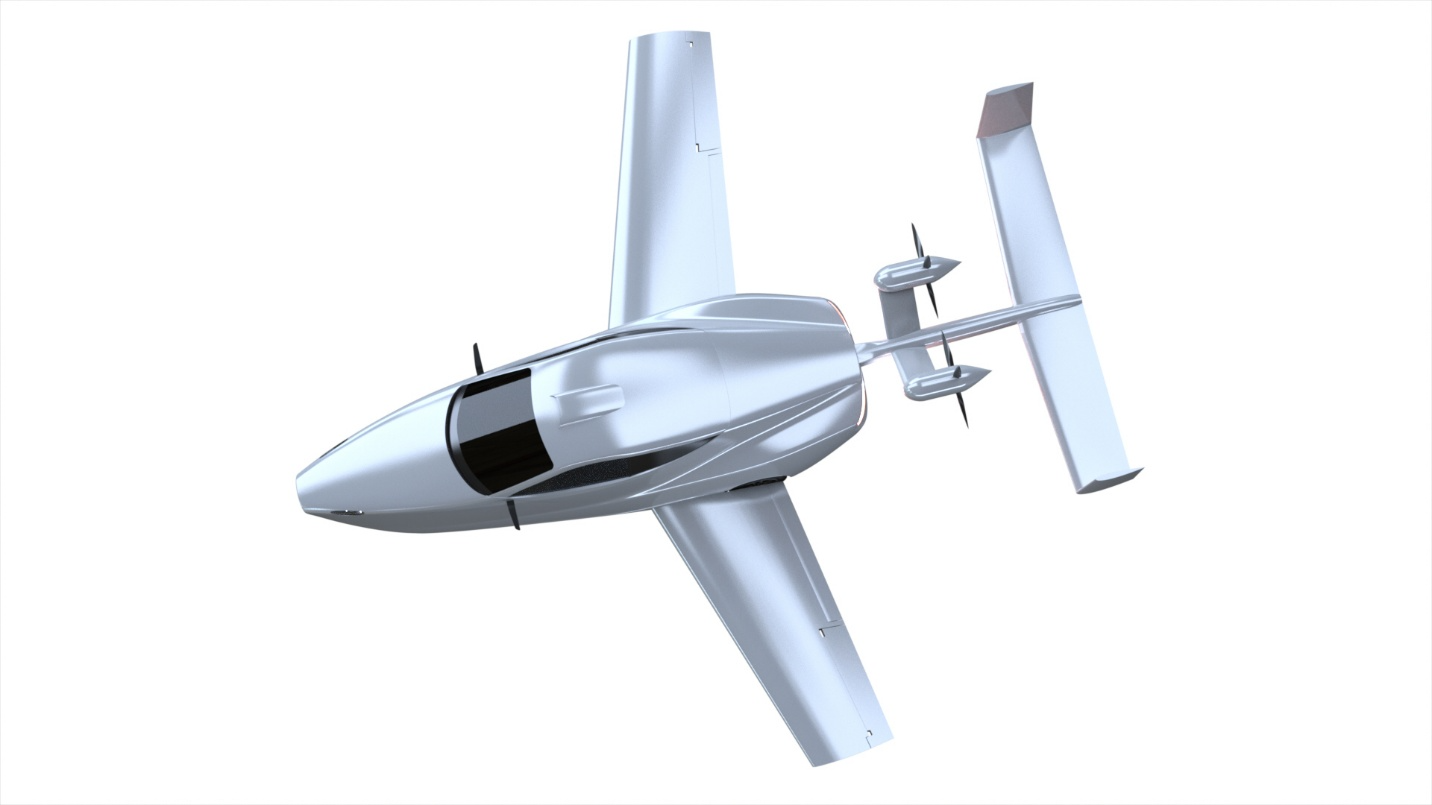
Radiator Test Prep
There are some unique challenges in testing the radiator system. You need to create a body of air that flows over and through the duct entering at the nose. To really test it you would build it full scale, drive it and see how it all works. But then you have something completed and would have to rebuild parts of it if you need to alter anything for any needed improvements.
As radiator systems can be tricky in any vehicle, we are wanting to test that early and separately. We had earlier planned to build a mockup of the front of the vehicle and bolt that to a truck bed and drive it down the runway to test at take-off speed. This is a little difficult to do safely, so the engineering team came up with the brilliant idea to create our own wind tunnel.
Not an enclosed wind tunnel like we used at the University of Washington, Seattle, for our flight model testing. We just need airflow onto the nose and over the front of the vehicle where the radiator duct exhausts the air at the windshield. We had the original flying prototype which put out tremendous airflow from the rear duct. What was needed was a way to harness that, straighten out the flow, increase the speed a little to get to take-off speed, and direct it where we want it to go. Simple, right?
Well, the makings of that are nearly done. We used cardboard tubes glued together to put into the back of the flying prototype ducted fan section. This will capture the air and straighten it out from the swirling airflow coming out of the duct. Then there is a short slightly conical section to neck down the airflow and speed it up. This exhausts over the nose of the vehicle and over the top of the nose towards the windshield to simulate normal take-off airflow volume and speed. You can see an image of the cardboard tube arrangement in the two images below.
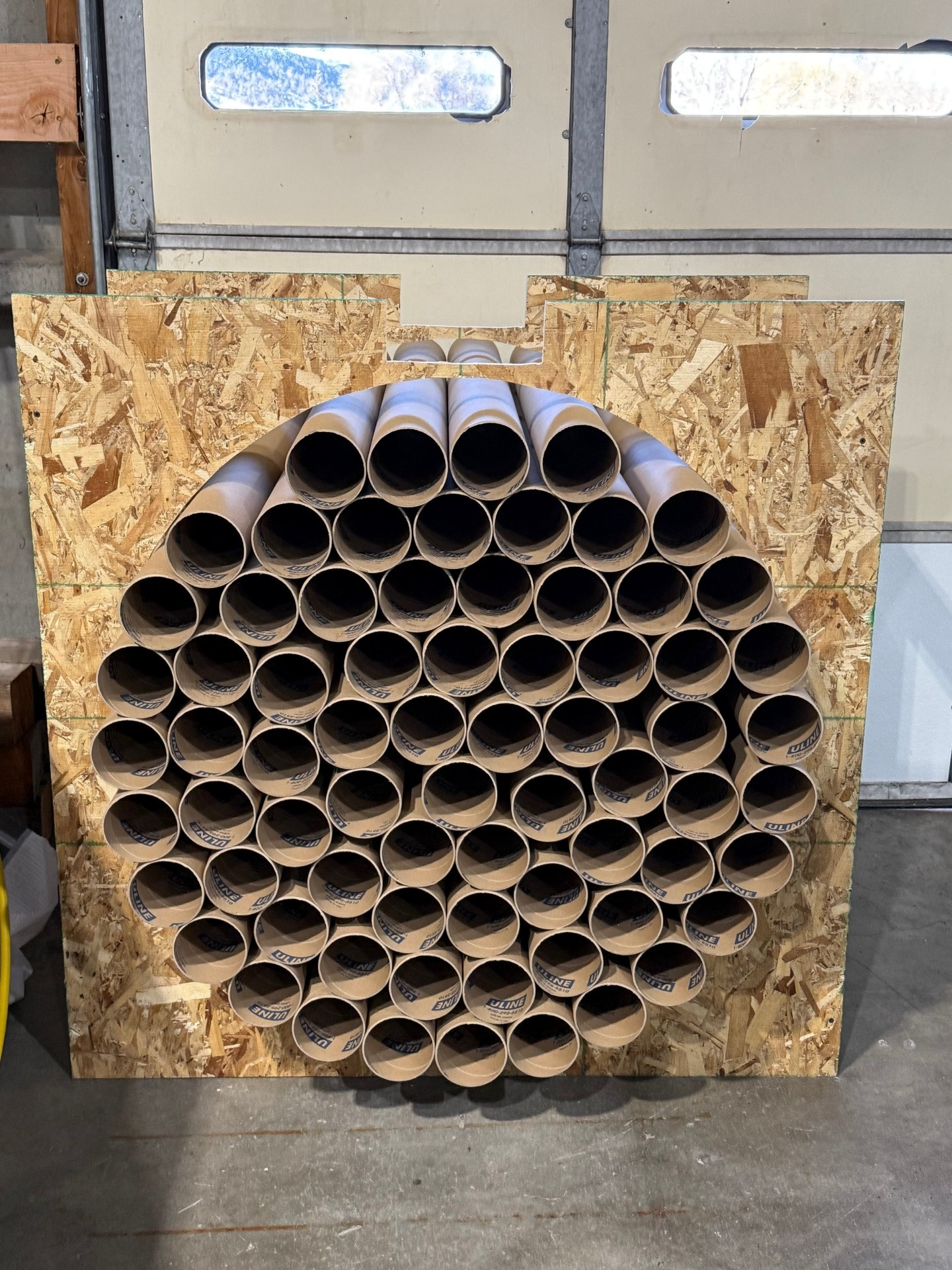
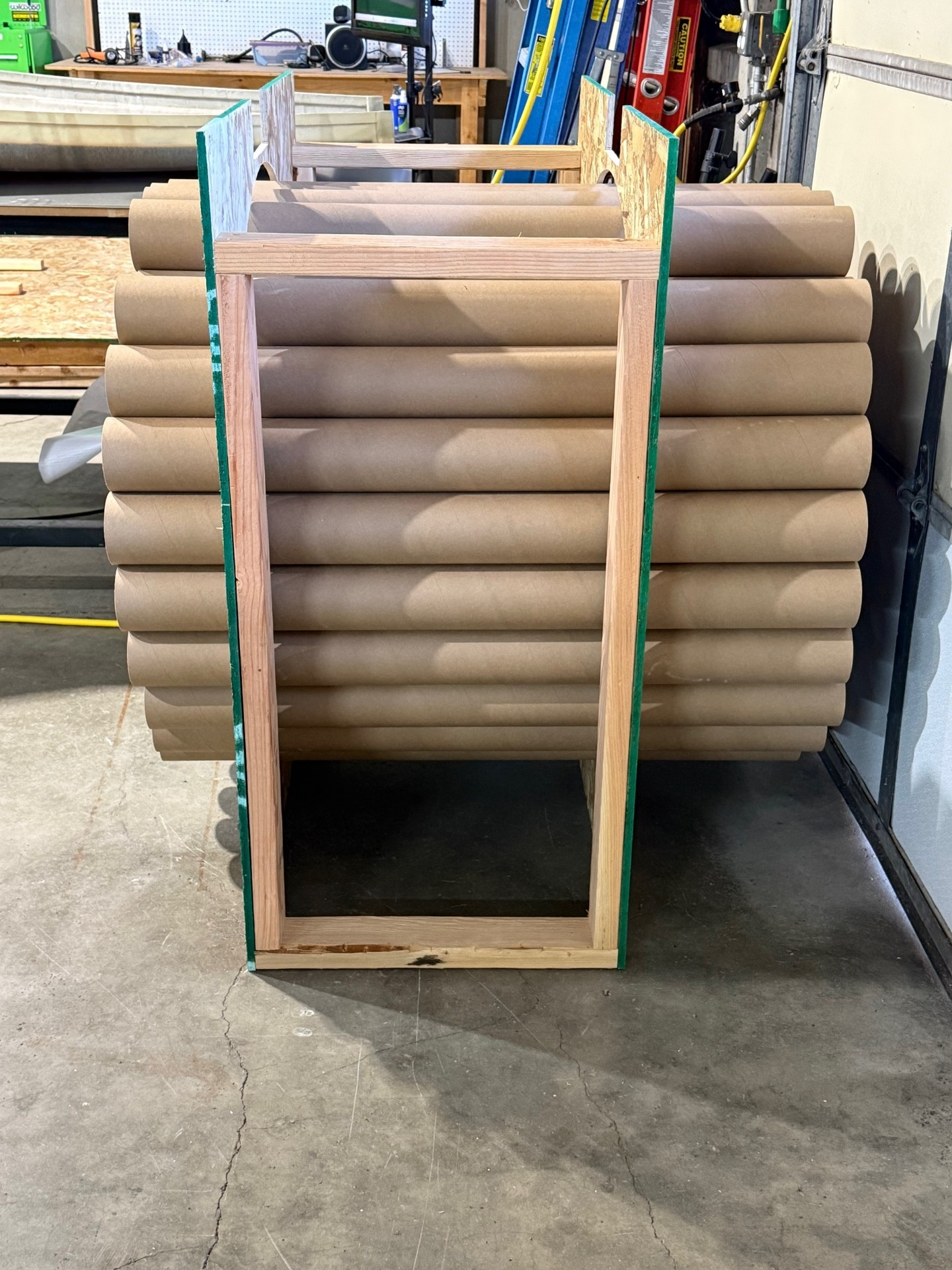
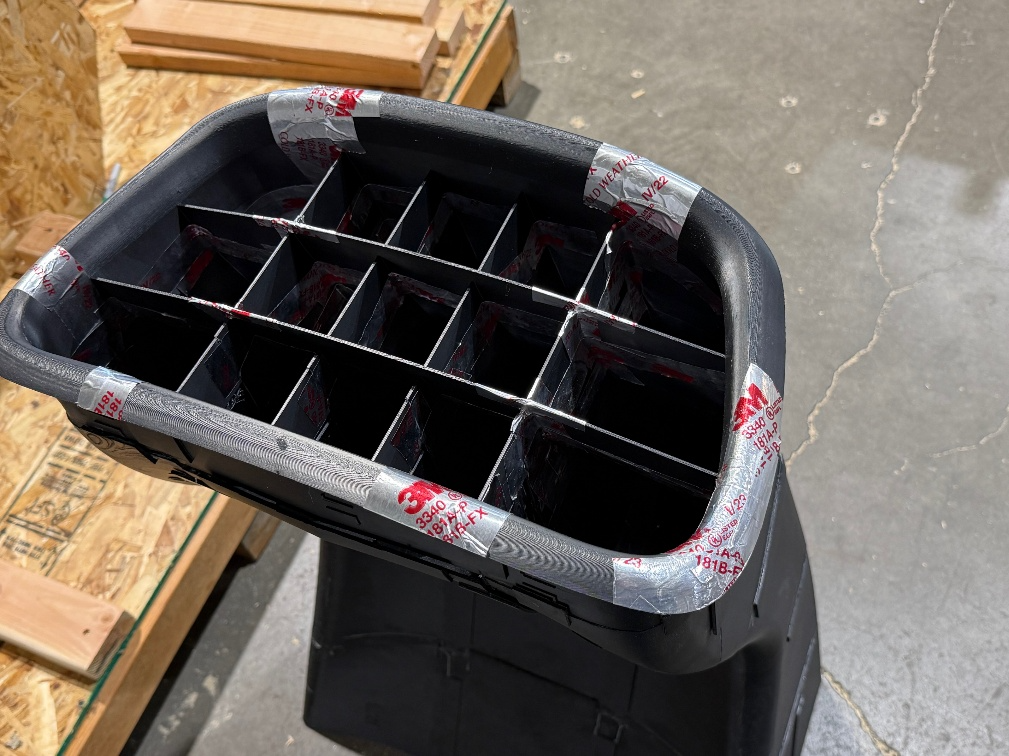
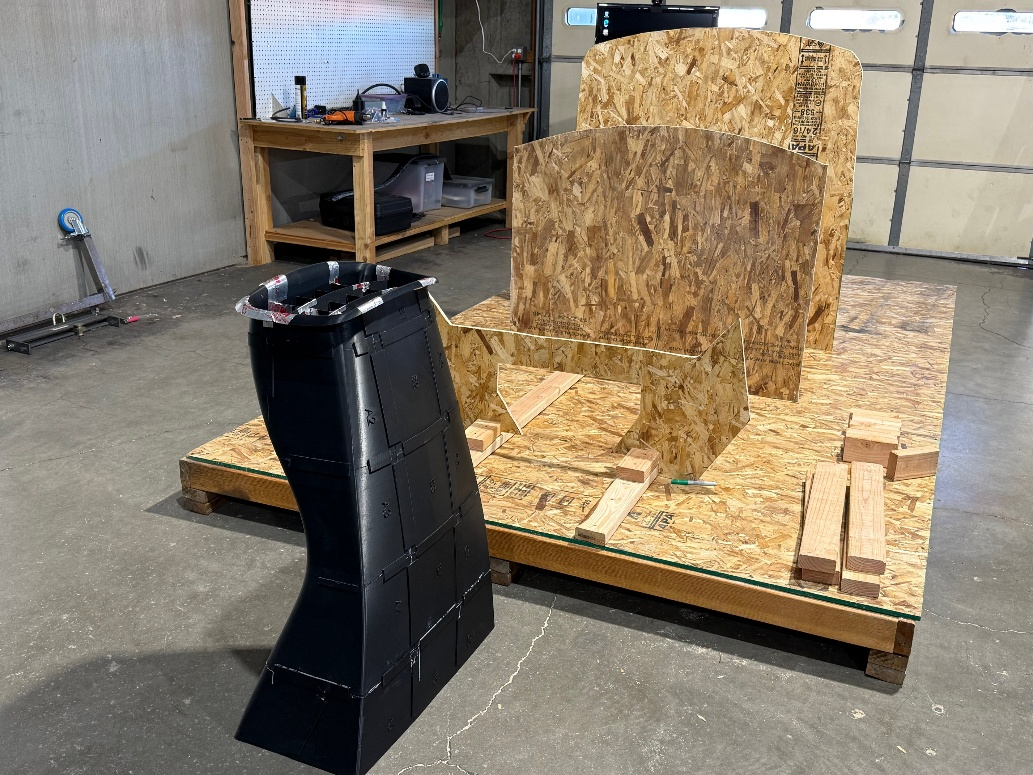
The tubes are to be bonded together so they stay in place as the propellers shove air through them on the way to the front of the radiator duct mockup. This mockup will be just the front of the Switchblade, using a 3D printed duct you can see in the images below. These printed parts are bonded together to form a very close mockup of the final duct and will be mated to a radiator on hand that is similar in size and design to the actual radiator we will use. This should give us a pretty good approximation of the airflow through the duct and out over the windshield while moving through the air at take-off.
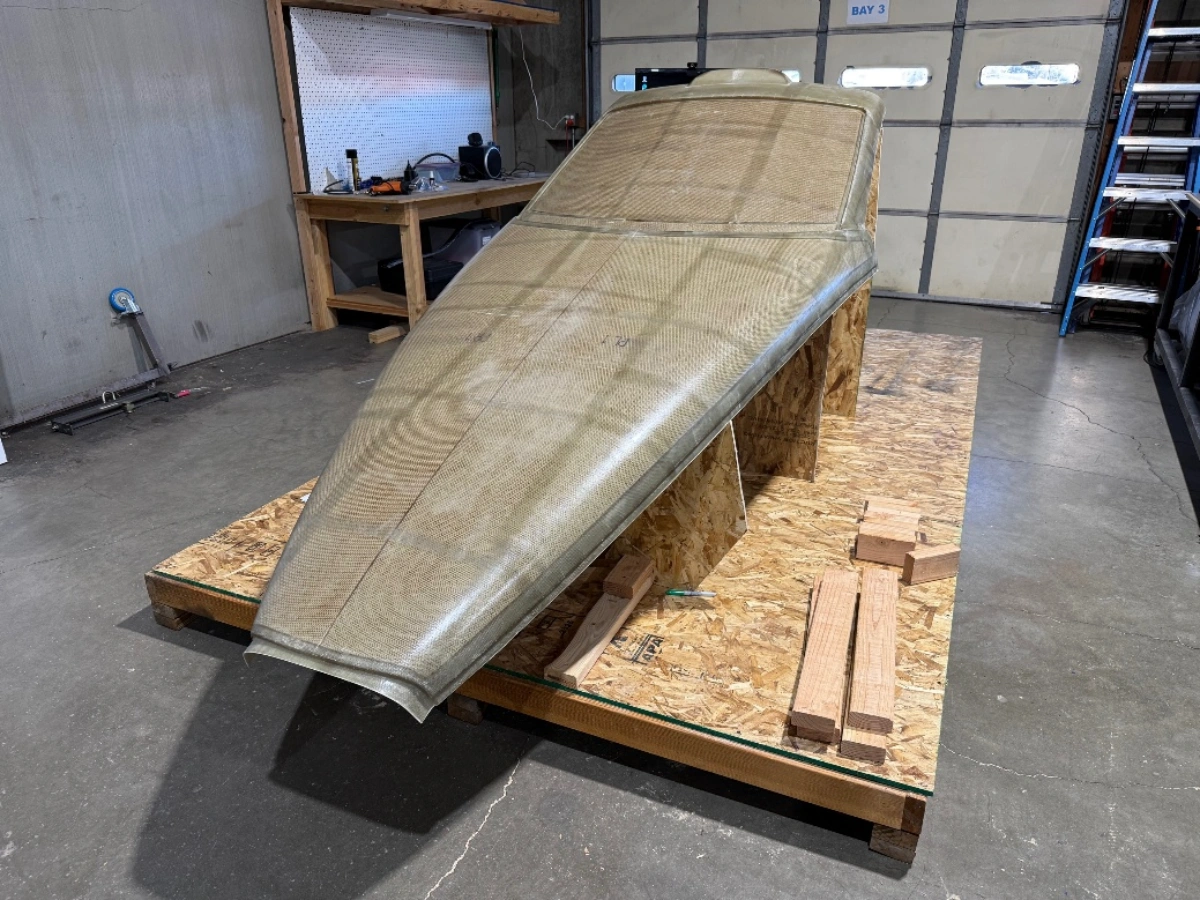
You can see in the image below the most forward 3D printed duct section (black) standing on the ground, the plywood cabin mockup behind the duct that will hold the radiator ducts, radiator, and model sides in place for the test, and the fiberglass skin that forms the upper part of the body particularly for this test. The sides of the vehicle will be the actual Switchblade parts as they won’t be modified like we may do for the top part near the windshield. The setup is to test the airflow through the duct, and the temperature drop through the radiator with the coolant heated to engine output temperatures.
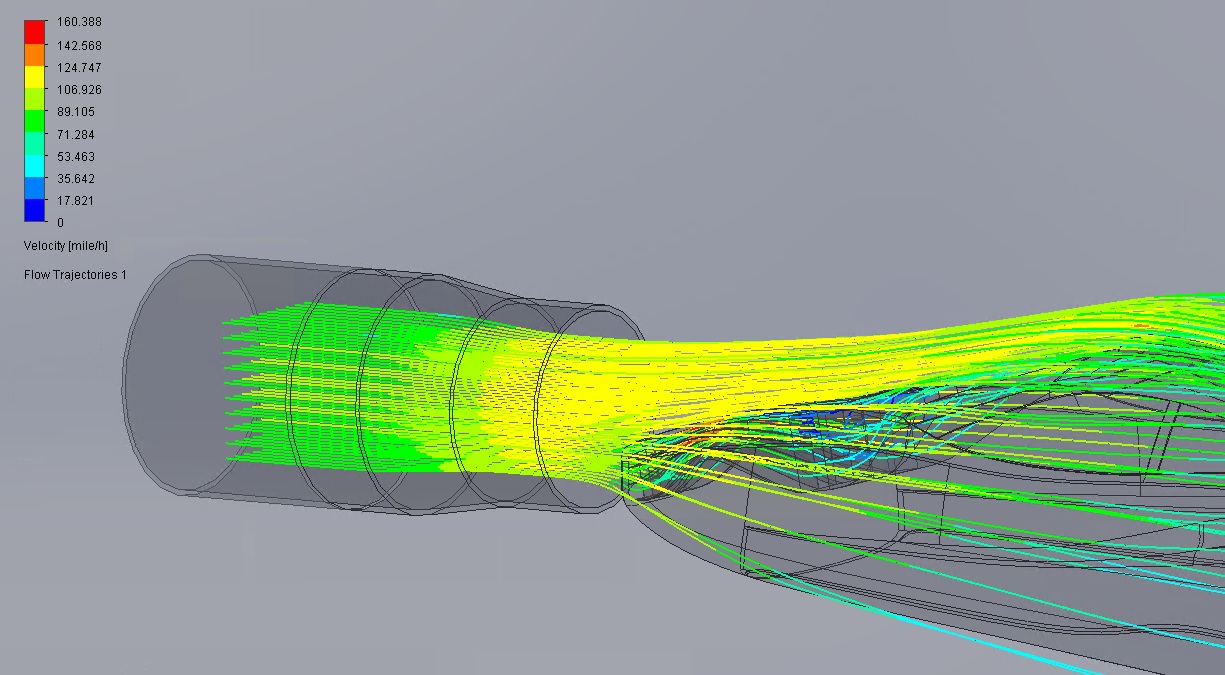
If we need to, we will modify the duct or radiator or outflow of the duct to tweak this into a working system prior to building the vehicle and then having to modify that. The bottom image is a computer-generated view of how all of this fits together with the tubes and cone shape on the left blowing air at the front of the vehicle and over the top to get the airflow we need for the test. The multi-colored lines show airflow speeds with green being slower and yellow being higher. This shows how we speed up the air by using a slight cone shape just ahead of the vehicle nose. The target is 100 mph at the nose.
We built a fiberglass nose and windshield to use in this test and then discard, as it will be easier to modify, and cheaper to make and waste afterwards. Carbon fiber parts are very expensive to make, so we didn’t want to waste carbon on a test piece like this.
Don’t you just love a movie reference?
In recent articles about our game-changing manufacturing program, I was quoted as saying: “Just having a flying car brings incredible prestige, but being able to say that you built it elevates you to Tony Stark status.”
Maybe you should get your Tony Stark badge and put a $500 Deposit down to gain a fixed delivery position. Deposit
Or simply put your name on the Reservation list to secure your Switchblade without any money down. Either way, you are making it known what you want to happen in the future. You want your own flying car! Reserve
I hope you liked getting a close-up of what we’re doing and that we didn’t make this too technical for non-rocket scientists! Please check out some of the many media stories we recently received below!
Switchblade In the News
Executive & VIP Aviation International – 55k private aircraft owners, operators and brokers reading monthly
https://evaint.com/samson-sky-and-air-tashkent-to-bring-switchblade-flying-car-to-uzbekistan/
bne IntelliNews – 200k Central Asian CEOs and executives reading monthly
GlobalAir – 400k pilots and aviation enthusiasts reading monthly
https://www.globalair.com/articles/samson-sky-gaining-runway-in-foreign-countries/12104
Blue Skies,
Sam
CEO/Founder
